Capture and execution of Guan Yu
The Romance of the Three KingdomsThe capture and execution of Guan Yu is the decisive end of his campaign at Maicheng: cut off from assistance and left with only a few hundred men, he chooses escape over surrender, but a succession of ambushes captures him and his son Guan Ping. Sun Quan orders both executed in the winter of AD 220; Guan Yu’s refusal to change allegiance gives his defeat its defining moral and political force, while Maicheng falls and his companions’ responses carry the loss into its aftermath.
The Siege and the Decision to Escape
At Maicheng, Guan Yu’s position has become untenable. He counts only about three hundred men, cavalry and infantry together; provisions are running out, and soldiers continue to slip away at night. He weeps as he speaks with Wang Fu, who had warned him against the campaign. Zhao Lei states that, because Liu Feng and Meng Da have betrayed them and no assistance will come from Shangyong, flight is their only option. Guan Yu accepts that judgment.
The north gate appears to offer a way out, but Wang Fu warns that the mountain passes beyond it are ideal ground for an ambush. Guan Yu dismisses the danger and prepares to lead a breakout, leaving Wang Fu with one hundred men to hold the city in the hope that relief may yet arrive. The decision is brave, but it carries him onto the route his enemies have deliberately prepared.
Sun Quan’s forces have arranged that route as a trap. Acting on Lü Meng’s recommendation, they leave the north as the apparent escape route while blocking the other approaches. Zhu Ran positions five thousand crack troops a few miles beyond the gate; Pan Zhang commands another five thousand farther along the road. Sun Quan consults the Yi Jing, whose hexagram indicates that Guan Yu will flee northwest, and sets the plan in motion. The escape is thus anticipated before Guan Yu leaves Maicheng.
The Ambushes and Capture
Guan Yu rides out at night with about two hundred men, accompanied by Guan Ping and Zhao Lei. They travel several miles before Zhu Ran attacks. Guan Yu forces him to withdraw, but the retreat draws the fugitives farther into the prepared ambush. When Zhu Ran’s men attack again, Guan Yu turns onto a minor road toward Linju; Zhu Ran overwhelms the rearguard and pursues.
The party then encounters Pan Zhang’s second force. Guan Yu again drives the commander back, but the repeated fighting and pursuit wear down his small company. Reunited with Guan Ping, he learns that Zhao Lei has been killed. By then, no more than a dozen men remain with Guan Yu. Each encounter has narrowed the escape, costing him men and strength while pushing him toward the final trap.
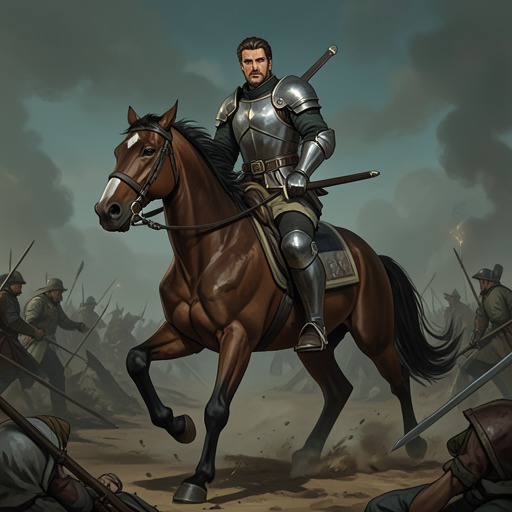
In a narrow valley, the pursuit ends with a third ambush. Ma Zhong’s men use grappling hooks and nets to bring down Guan Yu’s horse, Red Hare, and capture Guan Yu. Guan Ping fights to reach and free his father, but exhaustion leaves him a prisoner as well. Father and son are taken to Sun Quan; the breakout has failed, and Maicheng has been left behind with Wang Fu and the small force assigned to defend it.
Allegiance and Execution
Before Sun Quan, the capture becomes a confrontation over allegiance. Sun Quan says he has long admired Guan Yu and recalls his earlier attempt to bind them through a marriage alliance. He asks whether Guan Yu will now submit. Guan Yu acknowledges that he has been captured through his own mistake, but refuses to join Sun Quan. His loyalty, he says, belongs to the brothers with whom he swore in the Peach Orchard to support the Han; death is now the only remaining course.
Sun Quan asks his advisers what should be done. One argues that Guan Yu should be treated well in the hope that he might eventually join Wu. Zuo Xian opposes that course, citing Guan Yu’s earlier captivity under Cao Cao: despite the honours and gifts Cao Cao gave him, Guan Yu left and killed the guards at the passes. Zuo Xian warns that keeping Guan Yu alive risks repeating that outcome. The remembered example makes the dispute more than a question of clemency: Guan Yu’s record has already shown that generous treatment cannot secure his allegiance.
Sun Quan considers the advice and orders the execution of both Guan Yu and Guan Ping. They are beheaded in the winter of AD 220. Guan Yu is fifty-eight. The event therefore ends not with a change of sides but with the fulfilment of the choice he has just stated: captured by Wu, he will not serve it.
Maicheng and the Aftermath
The consequences reach beyond the prisoners. Red Hare is presented to Sun Quan, but refuses to eat after its master’s death and dies within days. The horse’s end echoes the story’s emphasis on fidelity, extending the severed bond between master and steed into the aftermath of the execution.
The heads of Guan Yu and Guan Ping are taken to Maicheng and displayed to Wang Fu and Zhou Cang as the southern forces demand the city’s surrender. Wang Fu had dreamed the night before that Guan Yu appeared to him covered in blood. Distraught when confronted with the heads, he throws himself from the city walls; Zhou Cang takes his own life. Maicheng then falls to the southern forces. The captured father and son’s deaths thus bring the city’s resistance to an end and are followed by the deaths of the men who remained there with them.
The event closes Guan Yu’s military career through a contrast between tactical defeat and steadfast allegiance. Sun Quan’s forces predict the escape route and use successive ambushes to isolate and capture him, while Guan Yu’s final answer preserves the commitment that had governed his earlier choices. The fall of Maicheng completes the immediate political consequence, but the loyal responses of Guan Ping, Wang Fu, Zhou Cang, and Red Hare make the ending a wider pattern of bonds surviving, or being broken by, the defeat.